We recognize the University is strongest when all its members have the support and freedom to thrive. The Libraries value and commit to creating inclusive, diverse, and accessible library systems and environments that support all university employees and students. Our physical and virtual environments will reflect a wide range of perspectives and experiences, and our programming and messaging will reflect our core IDEA values. In that work, we prioritize the creating of safe and inclusive spaces where students can learn with the support of experts and collaboration with their peers.
Foster Inclusion, Diversity, Equity, and Accessibility (IDEA) in all aspects of our work


Research and Instructional Services (RIS)
Open Educational Resources (OER)
The Libraries continued to support open educational resources (OER) by administering the OER Professional Development Grant for a fourth cohort of faculty. The Provost, Jeffrey S. Thompson, has generously funded these grants. Building on past successes, the 2025 program continued tiered grants based on student enrollment to help attract high-impact courses. Grants were awarded to 10 faculty members for courses in history, philosophy, English, math, French, medicine, physics, nursing, and journalism.
Participating courses and number of students impacted:
- English 101 (one instructor) – 66 students each semester
- French 316 – 10 students each semester
- History 101C – 60 students each semester
- Journalism 103 – 190 students a semester, plus more as this is rolled out to Career Academy students
- Math 122 and 123 – 100 students each semester
- Medicine 661 – 40 students each semester
- Nursing 407 – 150 students each semester
- Philosophy 210 – 150 students each semester
- Physics 181 – 350 students each semester
The Libraries estimate that this cohort will impact approximately 1,110 students each semester, generating student savings of approximately $111,000 each semester. Student savings from all four rounds of the grant program are estimated to be $895,000. Survey feedback from students taking courses in last year’s cohort showed that 96 percent said it was extremely or somewhat easy to access their free course material, and 71 percent said the free course material helped them study more effectively.
Sociodemographic data collected show a diverse group of students, including:
- 86% rely on financial aid
- 61% work full- or part-time
- 55% are female
- 44% identify as an underrepresented race or ethnicity
- 35% identify as first-generation students
- 20% are LGBTQ+
- 9% have a disability
Students have shared their thoughts on the impact of the Libraries OER program:
“It was really nice to not have to purchase a textbook as well as have the textbook available online.”
“The materials provided for this class are plentiful and interesting! There are always a plethora of resources that are either optional or required and they’re always interesting!”
Course Markings
The Libraries partnered with Admissions and Records, anthropology, and world languages and literatures to pilot a course marking program so that students could search in Class Search for any course that had no textbook or similar fees for the Fall 2025 semester. This pilot has launched and included a website to explain the initiative to students and faculty. The Libraries achieved its goal of launching the program University-wide in the Fall of 2025 for Spring 2026 registration. The program is modeled on language used by other Nevada colleges for a similar program so that transfer students will recognize it.
AB 345
The State recently passed legislation requiring NSHE to define low-cost course materials and no-cost open educational resources and to create a uniform system to identify and mark courses in the course registration system. The Libraries are following these developments and hope to participate.
Statewide OER Symposium
In March 2025, librarian Teresa Schultz led the planning of Nevada’s first statewide virtual symposium on open education. This free event provided a chance for faculty experienced with and new to open educational resources to gather and learn from each other. The half-day symposium included short presentations from faculty throughout the state on how they have incorporated open educational resources into their classrooms and provided the opportunity for attendees to ask questions about OER and hear how OER help students learn. Fifty people attended the event.
DeLaMare Science and Engineering Library and Makerspace (DLM)
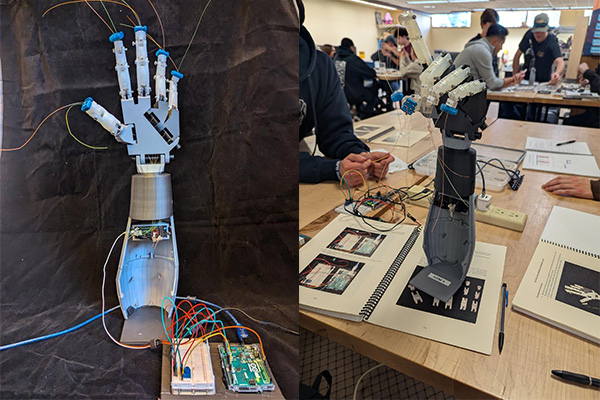
3D printed prosthetic hands – Engineering 100
The DLM Makerspace fosters innovation in mobility and accessibility by supporting projects that enhance independence for people with disabilities, including engineering 100 coursework that tests the strength and functionality of 3D-printed prosthetic hands.
Special Collections and University Archives (SCUA)
Sharing digital knowledge
SCUA continues to practice digital knowledge sharing by providing free copies of cultural materials to the Native American Tribes from which the materials originated or are related. SCUA has shared 198 archival items with two Tribes.
In January of 2025 SCUA shared 44 photos and 41 documents with an affiliated Tribe. In May of 2025 SCUA shared 113 mp3 interview recordings with a different affiliated Tribe. SCUA has another large digital knowledge sharing project in the works with heavy support from Digital Services.
@One Digital Media and Technology Center (@One)
“Resilience: Voices of Basket Weaving in the Great Basin”
Showings of “Resilience: Voices of Basket Weaving in the Great Basin” took place at the Nevada Museum of Art, Nevada State Museum, Waší∙šiw ɁitdéɁ Elder’s Dinner, National Association of Tribal Historic Preservation Officers (THPO) Conference, Reno-Tahoe International Art Show, Cordillera Film Festival, and Great Basin Anthropological Conference.
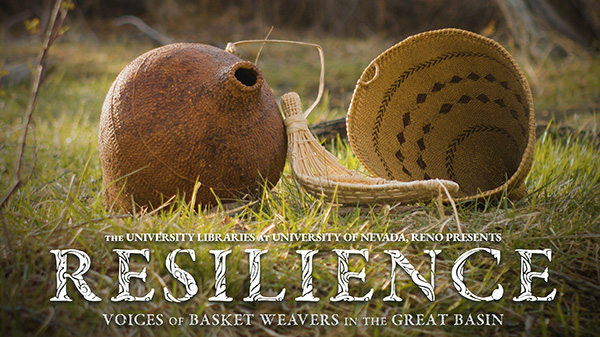
The documentary is an original @One production exploring the art of Native American basketry – its history, living practice, and future – through the voices of contemporary weavers, museum curators, and Indigenous artists. The film features Sue Coleman (Basket Weaver Washoe Tribe), Loretta Burden (Basket Weaver Northern Paiute Tribe), Melissa Melero-Moose (Artist Northern Paiute Tribe), Leah Brady (Former Chairperson of Great Basin Native Basket Weaver’s Association Western Shoshone Tribe), Anna Camp (Curator of Anthropology Nevada State Museum), Rebecca Eagle (Basket Weaver Northern Paiute, Western Shoshone, Washoe Tribes), Ashley George (Elder Northern Paiute Tribe), Billie Jean Guerrero (Director of Pyramid Lake Paiute Museum Northern Paiute Tribe).
The documentary was viewed by 70 people at the Nevada Museum of Art; 50 at the Nevada State Museum; 30 at the Washoe Elder’s Dinner; 275 at the THPO conference; 75 at the Reno-Tahoe International Art Show; 80 at the Cordillera Film Festival; and 50 at the Great Basin Anthropological Conference.