The Libraries empowers campus users to be active learners and critical thinkers. To support student success, we commit to providing the unique and equitable resources, tools, and spaces necessary for teaching and learning across the disciplines. We strive to support the diverse needs of our users and to contribute to the academic success of each student, both at the undergraduate and graduate levels.
Enrich the student experience and increase student success


Research and Instructional Services (RIS)
Dual credit
Dual credit offerings allow Nevada high school students to take University courses that can be used to satisfy both high school graduation and college degree requirements. When the curriculum is taught in the high school, it is called concurrent enrollment. As a part of dual credit initiatives, more than 7,000 participants from 36 Nevada high schools enjoy the same privileges as other University students, including access to the University Libraries and its materials, collections and resources. Participants can access Libraries videos, handouts, step-by-step guides, and Canvas modules to support learning research skills. Access to materials in the Libraries' Open Educational Resources (OER) Collection within the Libraries’ institutional repository is available to dual credit students and teachers.
AI Teaching and Learning
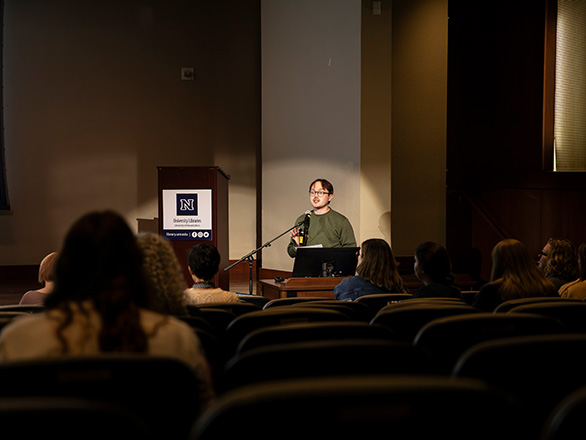
The Libraries’ Teaching and Learning with AI working group has identified ways to support teaching and learning with AI and addresses issues related to equitable access and ethics regarding the use of AI tools and the provision of AI learning opportunities. The group has evaluated different AI research tools and adopted AI literacy definitions and competencies. The group has also identified opportunities for library support of AI, such as through in-person and online instruction in the appropriate use of AI tools and the learning of AI competencies.
“When developing our guidelines for AI use, members of the Teaching and Learning AI group read extensively on different aspects of AI usage, including ethics, privacy, demographic trends, etc.,” said Ann Medaille, professor, director of Research and Instructional Services. “We discussed what we learned and distilled the content into seven distinct guidelines. We carefully wordsmithed each item to make sure that the AI guidance we are providing to the University community is specific, clear, and actionable.”
Guidelines for Use of AI
- Reflect on when it is appropriate to use AI tools and when it is not, depending on the situation and context. Make sure that your use of AI tools is consistent with the AI guidelines for your course, university, employer, or other approving authority.
- Prioritize human values. Use AI tools in a way that is consistent with enhancing and supporting your own and others’ agency, creativity, connection, and critical thinking. AI tools may be used to augment these qualities but should not be used to supplant them.
- Respect your own and others' privacy when entering information into AI tools. When selecting tools to use, check the terms of use, privacy settings, and training protocols to understand how your data is used and stored as well as to learn the potential risks of data exploitation.
- Consider the intellectual property implications of sharing others’ content with AI tools. If you don't have permission to use another person’s work (e.g., articles, images), then there may be ethical and legal restrictions on what you can upload into AI tools.
- Verify the accuracy of information obtained from generative AI tools using reliable sources. AI tools can generate false or misleading information, so approach AI-generated content with a critical stance.
- Be transparent about your use of AI tools, explaining how you used the tools to accomplish tasks or complete assignments. Be prepared to be accountable for any use of AI.
- Remember that large language models are not human. They simulate the process of having a conversation, aggregating information and presenting it as if they are thinking, though the output is probabilistic based on training data. AI tools may therefore perpetuate human errors and biases, which could have unintended and harmful consequences.
Access Services and Metadata, Cataloging and One-Time Acquisitions (MCOTA)
Implementation of Leganto
After the Libraries’ primary course reserves system experienced a critical incident, the Access Services and Digital Services teams rebuilt the platform needed for primary course support materials for the spring semester. Staff across Access Services and MCOTA worked extensively throughout the spring to format, clean up, and migrate nearly 3,500 lists of 49,000 citations to books, book chapters, articles, and streaming videos from the past four years of electronic course reserves.
A team across the Libraries and Teaching & Learning Technologies worked with their vendor to configure and roll out Leganto, a turnkey course reserves management system on July 1st. This system integrates with both Canvas, the University's Course Management system, and Primo, the Libraries' main discovery system for finding books and articles. Because of the hard work of the team reconstructing historic reserves data, faculty had the previous four years of reserves reading available to them for the fall semester, simplifying and streamlining the request and implementation of needed materials.
DeLaMare Science and Engineering Library and Makerspace (DLM)
Makerspace ENT 200 - Fundamentals of Entrepreneurship
The Makerspace supported 360 ENT 200 students for a course assignment to design, fabricate and sell items with a profit of $400. Fundamentals of Entrepreneurship introduces students to the cycle of entrepreneurship, from idea generation and validation to presenting the idea to potential investors.
Makerspace Online Modules
Over the course of the 2024-2025 academic year, 931 patrons completed the online Makerspace 101 training module.
@One Digital Media and Technology Center (@One)
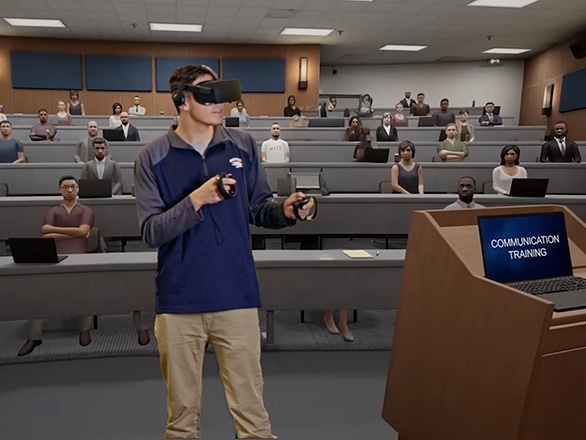
Ovation VR/AI
The @One team is testing Ovation VR/AI, a virtual reality platform that uses AI-driven feedback to help students practice public speaking and presentations. Launching in Spring 2026, @One will partner with the College of Business’s entrepreneurship courses to help students refine pitch delivery and with the Graduate School's 3-Minute Thesis competition to support participants in preparing concise, impactful presentations. These collaborations will enhance student confidence and performance through immersive practice and real-time feedback.